Taking up space

I accidentally took up tennis earlier this year. I played for the first time last year, with family, people far better than me. It was a lot of fun, but I knew I’d never be the fastest or the strongest, so I decided skill was the path forward. This year I started taking clinics at the local public club, a mere five minute drive away if I time the freight train properly. otherwise, it can be 20 minutes, or forever, if the massive freight trains stop on the track and go back and forth doing who knows what.

I’d probably held a racket once or twice as a kid, and when I went to my first clinic I discovered that no one had held rackets that way since I was a kid. The first thing I had to learn how to do was hold the thing. Nothing like new beginnings, but honestly, it felt good to learn something new.

As it turns out, tennis really suits me. It is both mental and physical, has strategy and attentiveness, and if I do not give it my full attention I either get hit in the face with a ball — even at my low level, as I have discovered, those things are hard, or I play really badly and get annoyed with myself.

After a few months of playing I started reading about tennis. I read Andre Agassi’s memoir, which is strangely boring, all about him except really all he wants to talk about is how much he hates tennis, and also Brooke Shields, whom he spends a significant amount of space saying unkind things about, such that one wonders what is the point? The book is well liked by the coaches and I think in part it is because it describes game after game and if they are older enough, they have watched these games. I probably watched him some as a kid, my parents played tennis. I do remember watching tennis. Jimmy Connor and Bjorn Borg and the meltdowns of John McEnroe.

This year I also read John McPhee’s Levels of the Game, about Arthur Ashe and Clark Graebner’s match at Forest Hills in 1968, which is also about everything else, their backgrounds, the way they were raised, how they came to embody certain types of tennis. As an aside, I lived in San Francisco in the late 80s and early 90s. Ashe died in 1993 of aids, and it was not until this book that I learned that he was straight. I had always assumed he was gay, and always assumed he had the double struggle of black and gay in early tennis. But no, not gay, he was one of the many who died from inflected blood in transfusions, before testing blood became the norm.

Tennis suits my mind. I can tell you what I do wrong, even if I can’t do it right. I am incredibly aware of when I am not doing what I am being taught, of how my body works, and what I need to do. Learning new complicated skills with the mind is only a first step, yes, I understand what I should do, but now I need my body to do it by rote, and I need my body to do it by rote when under pressure. Currently, my mind understands a lot of it, but my body doesn’t always follow. And if I think too much on the court it all goes wrong. There is a perfect zone where body and mind know what they are doing, and I let them take over and do it. The desired flow state that can be as hard to reach in tennis as it is in writing.

I could list the things my coaches tell me I do wrong — I don’t take up enough space, I don’t put my hips into it, these are the most common. When I first began to realize the kind of space I need to take up on a court to hit well, I also realized that having spent my entire life being told to take up less space, its really hard to do. After so many years of being alive as a woman, of living in cities, of navigating streets and darkness and people who don’t want me to be smarter than them, or more capable, I habitually avoid potential dangers through being smaller.

Yet here I am, on a court, when I need to spread my arms to full wingspan, to hit the ball in front of me, which means I need not only to be open like a starfish, in two dimensions, I need to also do it in three. “Hit the ball in front of you,” coaches say. Imagine you taking up all the space you possibly can in every single direction, then add a fourth dimension, MOVE, through space and time and keep all that extension. And also hit the ball, and then be ready in three seconds when it comes slamming back at you.

Naturally, I do not want to seem to do this, take up space. Naturally not as in, but of course, but by decades of habit the idea that I should take up all the space, flow through a stroke and then take up all the space on the other side…right. In my mind, though, I think this is a very excellent idea. I just need to take body memory and habit and replace with a new reality. No small task.

When I do it, it is glorious. It is strange to feel freed in space. I really never feel freed in space. When my head is so far into the game that I can take up all the space and play hard I also fail to notice anything around the game. That constant peripheral vision that I have been trained to attend to, to be so cautious about it, it all recedes, and the game is the game, and my body is my body, and my body was built for sport.

David Foster Wallace also wrote a book on tennis, String Theory. It is one of his books of extraordinary footnoting, the de-linearizing of his work. The story is not linear, tennis is not, in fact, linear, because you have to think in multi-pathways to make it work well. Wallace always touches on obsession and genius, but also on human limitations. I want to fight both for and against at least half of what he says, and I want my life to be different in way that I would have more footnotes, and more greatness. More obsession, for sure.

I started watching tennis after I started playing. All the things we are taught in baby tennis, which I find hard to do because one starts to learn tennis stationary, so a split step feels like an odd hop dislocated from time or purpose. Watching incredible tennis players though, is inspiring, and of course they do all the things the coaches teach, just faster, and with more elegance. Learning tennis, sticking one’s hand in the air while standing sideways on a court waiting for a ball to fall feels..awkward. Without the speed, I feel too seen, and not in a way that I am ashamed, but in a way in which my physical body feels dislocated from my tennis body. .

My tennis body is the interior version of me that is lean and muscled and plays very well. After a few months of clinics I started to dream in tennis, playing night after night, often working on a particular move or stroke. Sometimes what I learn in my sleep plays over into my awake state, but not enough, not yet enough. It’s time on the court that matters, ball machines and thousands of serves, and everything else I can do to optimize my body for success on the court.

Last week a coach joked with me that I should get a beach ball, or an inner tube for floating and swimming, and tape it to my body so that my arms and my racquet are always forced to be at least arms distance from my body. He said I should do this at home, and just learn to have space. I don’t think he understands why I don’t have space. This amuses me, perhaps, in general, I should do this, and let my arms expand out and shit the space in which I propriocept (is that even a word?) to get larger, to expand so that I am large, that I take up space.

I did not expect tennis to require me to reconsider how I take up space in the world. And it is, as one who has done this for most of their life realizes, very hard. I probably need hours and hours and months more than weeks on a court in which I simply take up as much space as possible. One day a coach yelled at me to take up more space and I yelled back, I am fighting decades of programming not to, give me a moment. And he stopped and looked at me, and the other women on the court with me all nodded their heads in unison. We know.

On those days in which all things align and I am fluid and take up all the space, of course I play better, but also there is a strange and deep joy of being in my body and not holding back and taking the space and racing from end to end and laughing with my compatriots, at the good points and at the bad. It is also very hard. But I do refuse to give up. And one day, perhaps I shall careen down city streets taking up all the space too, not quickly mincing out of the way of others, I shall hold ground, because it is not my responsibility to be smaller, it is my responsibility to be me.

Obsessive fact checking part I

Several years ago my friend Nicky Twilley sent me a short piece of a book, Feasting Wild, by Gina Rae La Cerva, in which the author states that the constitution of the Congo equated the Iyaelima people with wildlife, demoting them to animals so they were allowed to live in the forest. This struck me as odd, and unlikely. So I decided to fact check it. As it turns out, there was a single (specious) source of the ‘fact’, a piece for National Geographic Adventure by John Falk, a piece itself a horror show of racism, colonialism and misogyny, for which he cited no sources.

I was so appalled by the positive press the book was getting, and this bit in it, I read the entirety of the current Congolese constitution (in French), and the forest code of law. I read all of the law that Kabila instituted when he became president, still nothing. Then I reached out to a friend who runs an NGO on that forest and asked if he had heard of it, and shared the sources I had read in hopes to find any comment. He was deeply horrified, profoundly so, and said it was unlikely but that he would check with his local sources. While awaiting his response, I went and read all the Belgian Geographic Society’s notes on the forest, forest research, and legal creation, and still came up with nothing.

I commented on this back in the day when Twitter was useful and the book publisher reached out to me. I explained my research, and the horror, and she got in touch with the author and the book’s editor. The editor confirmed that Rae had used Falk as the source (horrifying to not reflect on the lack of citations and all the other concerns with what he wrote), and also then the fact checkers and the publisher utterly failed to check their data, and printed a book that dehumanized an entire tribe of people and inaccurately portrayed the country. They did tell me that they were going to correct the error in future printings of the book — I never did check, and attempt to address with readers of the first printing themselves, also something I never checked.

I also eventually got an email from the author, who also asked me about all the legal documents I read, and the ways in which Mobutu passed laws to expand the Salonga park boundaries. She asked if I wanted to be cited as the discovered of the false information, which I declined. Though I did respond with further detail on the tribal structure and the park laws and ancestral lands. I will note that some materials were hard to find remotely, so it is possible there was some document somewhere, but not one I found. She felt that it ‘sounded like something a colonial power might have done’ as why she didn’t dig further. I never did hear back further on this.

They were very nice, though I am generally disappointed at the quality of fact checking. (As an aside, when my Magnet book was fact checked, I was returned an ‘error’ on my behalf which they corrected. Their source was wikipedia and mine was academic journal papers. When I was teaching at Pratt and SVA, wikipedia was entirely disallowed as a valid source. Now, it seems to be canon (even though so often wrong) and it is the AIs that are disallowed. The needle may have moved, but it is still more false than I would like.)

All of the above took place in 2020, in the early days of the covid lockdown. Perhaps why I had time to read the constitution and forest law, but also, I was so annoyed by the casual dehumanization without citation, I probably would have done it anyway. Poor Nicky, after pointing this out to me, then had to suffer through my rage-emails at the horror, though I did of course share the resolution and the emails from editors and authors.

Poor Nicky, however, just got to suffer through my rage texting about a book that is so infuriating to me, that I also engaged in fact checking and validation of assorted conlcusions. This book enraged me far more than Feasting Wild, and deserves its own post, which I shall attend to next. (Manvir Singh’s Shamanism, is that book.) In general I have a rule against writing negative book reviews, as author’s spend a lot of time working hard on their topics and just because I don’t like it doesn’t mean that I need to tear it down. However, stay tuned for Part II of this, because here I feel very strongly.

Fifteen

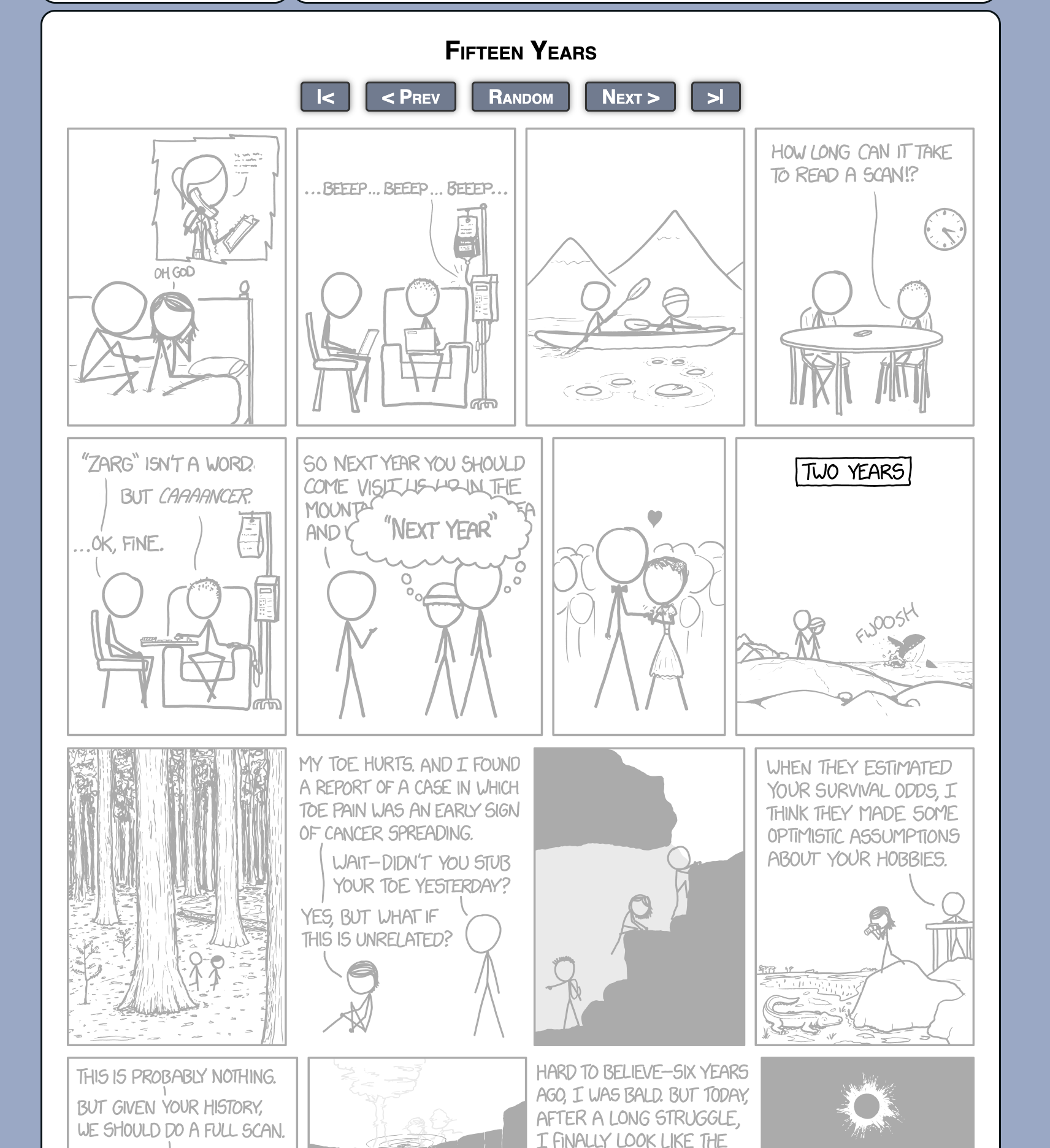
For some reason, this refuses the embed, so the link to the full thing is here.

I laughed when I read this, particularly the estimated odds of survival and optimistic assumptions about hobbies panel. I don’t have any particularly dangerous hobbies at the moment, other than the phd-induced-psychosis, which ought to be in the DSM-5, but I am pretty sure isn’t, and which I shall shortly recover from. I do, however, desire to have more dangerous hobbies. I could use more arctic kayaking expeditions, and definitely a return to scuba diving all over the world. I miss working with bronze sculpting, but I don’t think that really shortens my life span.

I know quite a few people who have made it to the fifteen year mark. I know that five is the one where the doctors look away, but I find fifteen, which I am not far off from, to be more significant. Perhaps because there is more time to look back on what happened AFTER.

After reading this two days ago, I found myself thinking about what I would do differently if I went back to that time period. Not to change the diagnosis, or even the treatment choices (though I might), but how I attempted to put my life back together afterword, what that entailed, and how I did. If I gave myself a grade, it wouldn’t be very high. I’d have failed out and probably in that mode where the teacher takes you aside and says, ‘maybe this subject isn’t for you,’ except of course in this case that subject is life.

Despite being in two of the best cancer hospitals in NYC, and having reasonable health care coverage for America, the aftermath was a shit show. I suspect the process was as well, but as I liked to joke at the time, I was busy with the survival bit, all the rest could wait. Undergoing cancer treatment and living in NYC without paid sick leave decimated my savings and put me into debt. I was in my mid-30s at the time, and had a very nice savings account with which I intended to buy me a flat of my own. Post-cancer, not only was that gone, but I had acquired debt on credit cards. Some was medical debt, some was my radiation survival technique of buy a new dress a week, for six weeks (retrospectively, weird, but ok, that happened).

I was diagnosed with cancer two weeks after I graduated from Columbia Business School. Three weeks before the end of school I had quit my high paying job running CX for AOL Products. The politics were hellacious, the constant end of year reorgs frustrating, and I had been transferred out of working with the product people I loved onto a New York City-based media and content focused team, and the culture shift was agonizing.

There is a lot I’d like to say about the family process of navigating cancer but I’d really prefer everyone I wish to talk about were dead before I do so. Let’s just say that with the exception of spending a lot more time with my uncle, much of that time period felt like being regularly slammed in the head with something painful and then needing to turn around to make sure the person who just smashed me was OK.

To be frank, most of having cancer seemed to be about the care of others. People who were so distressed when I told them, I had to hold their hands and tell them it would be ok. People whose response was to tell me of a friend that had a similar diagnosis, often ending with, “… oh and then they didn’t make it,” and me asking, “and why did you think telling me this was a good idea?” I suspect that everyone who has ever had cancer experiences the really weird things people tell you. Part of my memory of that time is of me, peeled slightly away from reality with the colours a bit dimmed and the lighting off, listening to people interacting with me, but really not with me. It was a dissociative stance, I suppose, but I can feel myself making the same expression now, and I am leaning away from the keyword, puzzling out the oddities of it all.

A lot of shit happened. Some friends disappeared — also normal, my husband whom I had been wanting to divorce lost his mind and tried to steal all my money and demand that I go through all kinds of hoops to get through this. At the time, NYC was NOT a no fault divorce state. In my opinion, he was entirely at fault through dint of being a grasping asshole, but that wasn’t one of the options and would have required going to court. He held me entirely responsible for his not getting the green card he wanted, even to the degree of accusing me of going behind his back to the USCIS to somehow block this. Can you feel the crazy? I can, but I can’t lean any further away from this machine and have my fingers reach the keys. I can, however, also feel that anxiety pooling up in my chest, that feeling of being trapped and having no way out.

After I finished treatment the doctors waved their congratulations and disappeared. Years later I learned I should have had mental health assistance — cancer along with heart attacks cause significant post-treatment depression cycles. I was already probably deeply in one during treatment and my doctors should have noticed, based on what I was telling them, but nothing came of it. I also learned, years later, that at the time they did NOT prescribe mental health support lest us women (specifically) convince ourselves we are depressed and demand treatment from an overburdened system. Apparently as well I should have begun physical therapy, because the extensive internal scarring from three surgeries limited my motion. I have no idea why this never came up nor was it suggested. When I finally started dealing with it, eight or nine years later, every PT and otherwise person I saw was a mix of horrified and astonished, and also sorrowful because having waited that long, it would be nearly impossible to return me to something near my original form.

Unlike the XKCD comic, however, I never really managed to find my way back to believing I was going to live, for at least the first decade. I had decided full stop I would never undergo treatment again, so after the first few years of check-ups every three to six months, I simply stopped going. I could not settle back into work or do things I disliked, but I also could not choose to do something hard that I love that could take years, because I didn’t expect to live that long. Not on the surface, but deep inside, in the way that behaviors seem to just happen, and it took me a long time to think them through.

Thinking about the last fifteen years, if I could pop back, to cancer treatment, not to the before, there are so many changes I’d make in how I chose to live my life. It’s irrational to think if I popped back I’d suddenly have the energy and agency to make them — I was exhausted for a good five or six years post treatment, but I like to consider.

I find me now wondering if I went back and did things differently, where would that trajectory have taken me, would I still want to end up at that place in my life, and what is the fastest way to traverse the glacier and the massive cracks to get myself back to a place like that. If this is what I want.

Foolishness, of course. It doesn’t work like that, and the better question would be, where do I want to go now, what do I understand from all that crap that happened, and what I would have wanted to be different, to move into the place I want to be now. I think, weirdly, cancer treatment and the aftermath broke my ability to dream. I recognize this, but I am not sure I have fully recovered it. I find I am still able to easily pop into the post-C crisis mode I used to refer to as dragon-state: I wish to hoard, money, people, books, shoes, dresses, and sit alone on them in a cavern where no one can get to me. Pretty unhealthy. But also funny. I think it would be better to be a sociable dragon. I could use the claws and teeth and fire. And the sense of safety I imagine I would have if I were a dragon instead of what I sometimes feel like, just a girl, in a world that is hostile to girls.

I finished treatment near my birthday and invited the women who had supported me through it, 14 absolutely wonderful people, to dinner in NYC. It was incredible and I could see that one deep and internal thing in me had changed through the process, I was more willing to ask for help, to be present with people, to not always insist on being the edge-girl observer. My friend Sara created a book for me, each person put in a photo of us together, and wrote a note, and Sara, crafty designer that she is, made it beautiful. I pulled it out today, I still love all these women, though I’ve not been great about being in touch. A little too much lonely dragon in the dark but without her hoard. (Except the shoes, there are so many shoes, still.)

There were amazing men as well, Seth and James in particular, but for that dinner, it was all the ladies.

Everything crooked can be straightened. Every path can be regained. I have always felt, even when not acting, that the future can be anything I want, if I dream and if I reach for it. I have this image in my mind that I wish to draw on my chalkboard wall. The path I took, the path I’d have preferred, and the path of now, with all the dreamed of outcomes sparkling at the end, with all my friends and full of love and interesting things and creativity and tasty things to eat and drink. Not sure I’d buy more shoes though.

I’d like to write the real stories, the terrible things. They are funny and horrible and awe inspiring (and not in a good way), yet something in me feels they should be spoken. I had a blog at the time, called TIBY (the yellow blight), full of rage and frustration, which would make good interludes, but the stories of how people manage the frailties and weaknesses of others, at least in my worlds, can be very dark. Or more precisely, how people handle their own frailties and weakness in light of things that scare them, that they cannot control, is not always grand.

I am happy for Randall and his girlfriend that their fifteen years has found them in a place of love and happiness, alive, together, and hopefully still taking photos of crocodiles and falling into the holes that sometimes open in the post-cancer world, but fishing each other out.

I shall fish me out, of this thesis, of the past, into the boats, and across the water.

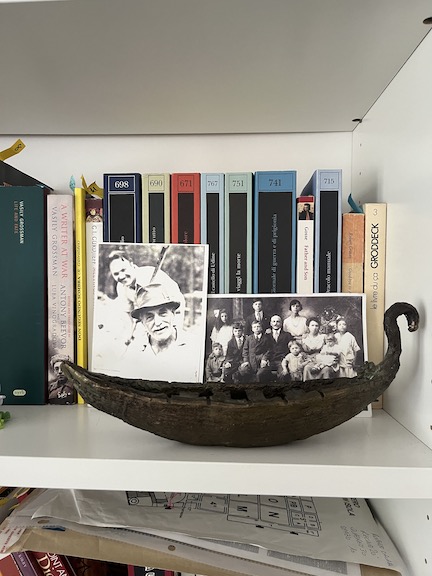
A bronze boat I made using lost wax processing, modelled after Urshanabi’s. In front of my grandfathers, and books from The Adelphi Project, above the map to Roberto Calasso’s grave in Venice.

A year without books, part ii

It has been 7 weeks since my rash decision to not only not buy textiles for a year, but to also buy no books. My friends have been doubtful that I can do this. Reasonable. I buy books. I own books. I also, thankfully, read books. 45 more weeks to go.

Strangely, it hasn’t been hard. At least not yet.

I’ve acquired the Libby app, which I must say, I love. I’ve been reading NYRBs that I don’t own, and listening to books as well. I feel a bit bad it took this long. I’m afraid to calculate my usual annual spend on books, mostly paper. I suspect that while I have bought fewer in the past four years of PhD, I have bought significantly more expensive ones, (thank you, springer and routledge, for ensuring that tasty knowledge only falls into the hands of the wealthy).

Speaking of rage for the insanely expensive academic book, I needed to access a springer book on an anthropological study of spirits ($179.95), which resulted in me acquiring a UT Austin Courtesy Borrower card, which cost me $55 (because I was in a rush and didn’t have weeks to wait for the city of Austin to give me something that will make it free. ok maybe I wasn’t in that much of a rush, but I was. If you know me, you get it.)

So now I have the Libby app, and another local library card. UT Austin has a lot of libraries, I could drown. But I am trying to refrain from walking the stacks for the glorious serendipity because I have only a few more months to finish writing up the PhD, or my head will explode like old sci fi tv when I hit the perimeter.

As an offset to the PhD, I read a lot of mystery novels, mostly bought at the local Half Price Books. I refer to them as the ‘sorbet course’ and I forget them as soon as I have read them, but I have also spent two hours not thinking PhD, and it’s a bit like sleeping, but no stress dreams.

Strangely, I’ve been craving books about/by artists and their practices. I have a few shelves on this, so I am slowly starting to read some I had not, and re-read some I had. In the absence of creativity — at the point the phd is purely instrumental — reading about it, whether craft, art, creation, ways of thinking, or simply looking at images, seems to be doing something for me. It makes me hungry, and it helps me dream of a future when this thing is done.

I’ve been reading Jeanette Winterson’s Art Objects, which has a quality of moving between images and words that I resonate with. For most of my life I was more attuned to words and movement (dance), than visual art, but then something changed in the past years and I am also far more interested in visual arts than I used to be, I hunger to understand more. First, the scaffolding, but then, the specifics.

I’ve also been reading Katy Hessel’s The Story of Art Without Men, which is…odd. It has a lot of ‘my favorite painting or work by this artist is X’ and I really do wonder why, when describing the art made by women over the centuries, she needed to go into Artemisia Gentileschi’s rape or Camille Claudel’s guy problems. Even though she wants to put the history of female artists back into our minds, she still centers men, in many instances. Also, she does not much mention where all this information comes from, and so I wonder who the art historians are that kept all of this knowledge alive. That aside, I am still enjoying the short histories and images.

I think I have actually read more books since the ban, and I have been in several bookstores without needing to buy books. (Though I did ask Wayne to buy me a $5 used kids book in a record shop in Wimberley last week. Did that break the rules? Maybe.)

Frankly, I hope this becomes a way of life rather than a blip. In concert with this, I have been trying to downsize the books. Today I took about 60 books to HPB, and they gave me $22.00. This exchange so annoys me I would rather give the books away. I know they will sell them for a lot more, and that this is how they make money, but it feels so unequal. Why not a dollar a book? Why pennies? Don’t they know pennies are over?

My Austin neighbourhood has a lot of little libraries, so today I snagged a book from there. I would say that I as of yet feel no pressure or sense of loss about not buying books. And even those that I am saving in my phone (by taking photos of their covers) do feel like they could wait til later. I may be a bit late to some of the books, rather than reading what is just out, but what’s a year in the grand scheme of things?

I took my $22 and bought two months worth of coffee filters and three lottery tickets. I figure if the books bring me a million dollars, that is a fair exchange! Never happens though, I am never a windfall girl, I always get offered the work to generate the money. But as my Russian friends say, hope dies last. I hope Santa brings me some books.

So here we are, I’ve bought no books, I’ve wasted your time with this ramble, I am reading about art and dreaming of making things again, things beyond words, but I am still trapped in the spin cycle of thesis words with a few months to go before I am ejected into the sky. I’ll use my saved book dollars to glue together some wings, and hope to get neither too close to the sun nor to close to the sea when I make my break into mid-2026 and the light-loaded futures I desire.

Linguistic Geography

There really is no such field, but sometimes there are small toe taps towards it. It’s actually a terrible title, but trying to find a name that fits what I am trying to say inevitably ends up with too many words, all of which someone or many someones would argue the meaning of.

Linguistics is most commonly understood to refer to structural linguistics. This is de Saussure in the beginning, and to grotesquely oversimplify, it is syntax and phonetics and morphology and semantics. More about the form than the meaning. To me, this is the mathematics of language. Or the desire for one. We are in the land of signs and signifiers and the signified. There is much comparison between systems and languages, and the evolution of languages. Computation linguistics rolled out of this bed.

Originally, this looked at language as separate from context or culture. Sociolinguistics and linguistic anthropology, in addition to including new methods of study, looked these two Cs. My undergrad was in structural linguistics, but I dual majored in ‘Language and Culture’ with emphases on French and Japanese. (At the time I spoke both very well, the Japanese is somewhere stuffed in my head now, appears in occasional bursts of oddity, but mostly I haven’t relocated the door to that fluency. Maybe one day.) My masters degree was a mix of linguistic anthropology and sociolinguistics. Georgetown at the time was most renowned for Deborah Tannen and discourse analysis, however I was more interested in hybrid languages and authority in the internet (late 90s), and focused more on pidgin and creole studies as well as basic methods and analysis. I studied the language and culture of internet communities, how authority was marked online, and in particular how it was marked in second language speakers. I didn’t end up writing my thesis on this however, just a series of papers. My thesis was on the prescriptive language qualities of software tools — spellcheck and grammar check. At the time they were newish tools and aligned to no standard of grammar that existed in American English. What was grammatical was driven by the marketing department, as there was a limit to wavy lines that people could take. Also they severely disavowed any type of ‘humanity’ (who, which) for anything non-human, and a few other strange tics that indicate a world view that is probably deeply embedded in heads and writing styles for those who have used such tools since the 90s.

Fast forward past the MBA (in which, probably obviously, not only did I focus on models of quantifying the value of design and the investment in design, I wrote a fair amount about how language impacts everything from tax planning to financial models.), I found myself in a PhD program.

Language and geography are curious bedfellows. In some ways, language is always interesting, as it is the medium of all these fields. Not that I want to dip into the philosophy of language, but it is hard not to be endlessly aware of how difficult it is to bind such words as language, communication, knowledge, place, etc. Not only in the field of geography.

Starting my PhD, I was very interested in what had been done, theorized, understood about language within the field of geography. How does language show up? Does linguistics show up? What does it do in geography? I could do the long lit review here, but that would be a bore, I suspect. So instead, some generalization.

One of the most interesting places language shows up is in the schemes for GIS data. Is it a mountain or a hill? How to deal with spatial and conceptual variation? For many decades, this is the place that adopted the title of Geolinguistics. It expanded outward with the interests of particular individuals to look at language distribution, particularly as it relates to the physical places, and then to dialect variation, language planning and policy, and power. There is also a great deal of geographic interest in the names of places, how they were named, what they mean, particularly in the UK in the context of colonialism. (The political geographers are into the philosophy of language, but we are not heading there.) In all instances there is some ‘there there’, in effect, geolinguistics suggests that languages are contextual to places, and this must be considered.

If you asked a linguist about this, I think they’d find the geolinguists naive in suggesting that the linguists are not thinking about this. There is a book called ‘Linguistic Wars’ on a different topic than this, but you can see how the linguists do like to argue with each other. The Chomsky Lakoff debates were not always civilized. (In fact, when I was a masters student you had to do your entire degree in one theory structure or the other, or you would have to start over because you had had your head filled with nonsense.) The basis of this argument was about generative grammar — meaning is driven by underlying syntax etc vs syntax being shaped by underlying meaning.

And the Linguistic Society of Paris/Société de Linguistique de Paris forbid discussions on the origins of language in the mid-1800s. The London Philological Society followed suit a few years later. Too much infighting — of which there are some really great and crazed stories, so they basically shut down a huge swathe of what linguistics and philosophy could discuss, for over a century.

Let me just take a huge step to the left here. And get into the messy space between language and communication. There are quite a few theorists over the centuries who argue that language is the most human of human traits. That language is what makes humans unique. And then in the past decades, researcher after researcher publishes that other species communicate. Sometimes it is referred to as language, as in the case of whales, who are also known to have dialects. Sometimes, as in Kohn and Simard, trees communicate. There is the dances of the bees, as well.

Let us accept the premise that language is not a human-only trait. Let us accept that many if not all beings have the means to communicate within their species and sometimes with other species as well. This gets very interesting. Trees and whales have both been on this planet far longer than humans. I am unsure what the evolutionary linguists are doing these days, but I have yet to see evidence that they are tackling non-human linguistics. Most of the word on non-human language or communication comes from fields specific to the species being studied, biology, botany, and the like. There are some people working on theories of animal languages; there is a great deal of interest in using AI to translate these languages for human consumption.

There is a great TED talk by Karen Bakker, called Could an Orca Give a TED Talk in which she addresses interesting questions such as the ethics of overlistening to other species, and whether or not they want us to understand them.

But back to geography, a study of place, of the physical features of the earth, of human activity and distribution and population and so much more. There is physical geography, human geography, and cultural geography, and many sub-fields beside. My study of language doesn’t necessarily fit cleanly in any of them — it’s not about the humans, it is about physical places, everything is or has culture (one could argue but let’s not do that now), so it could fit there as well. But much like most of the humanities there is so much overlap that the fields seem to be what one says they are, with some historical differentiation by qual or quant methodologies. Which to me, seems a bit arbitrary, and now as more methods are birthed into the world, even harder to draw lines.

As it turns out, attempting to theorize how a place has language, and what this means for language, communication, knowledge, and place, is far too big for a PhD thesis. Even attempting to define what I might mean by all of this is, to use technical term, nuts. It requires re-arguing an ocean of accepted ideas to make it academically legible, and most everyone I’ve spoken to about this, finds it interesting, they also find it impossible.

The questions though, are so very interesting to me. If language evolved to exist on this planet before humans, does that change what and how we define language? Modern human language is a symbolic language, however there are endless instances of non-symbolic languages transferring information or knowledge. This runs us into what is language — is it a tool with a particular structure, or is it a means of communication? If we define language as the means of sharing then we can extend into systems non-human with greater ease. Then we get to argue about how we know. If I am certain that tree passed me a message, how can I know? How can I convince you I know? Granted, if I told you another human told me something, you believe in the possibility of the tool, but you cannot know if I am truthfully reporting, or if I even understood what they told me and am reporting what I believe to be true, even if it is not in actuality.

In the place based research that I have done as the basis of my thesis, place matters. It matters in the existence of the language, the type of language and the evolution of the language, but it also impacts the culture and communication modes of the humans, as well as the humans with the place itself. What does that even mean, you wonder? In the simplest form, some places require certain languages, and these are not always the commonly spoken human languages of that place. In effect, there is a different way to speak to a place, because the place insists on this. Or, you could ask, does the human insist and have they fabricated this all? Topple off the cliff of philosophy, fall into a tar pit of semantics, and circle back to the ancient days when animals and rocks and trees had tongues, in the metaphorical sense, and I wonder, mythology, or were the humans more open to listen?

Nonfiction Research

By which I refer to nonfiction.co, a research organization that produces interesting and beautiful reports, and seems to manage to have long time frames in which to do this research.

I’ve been fortunate in my career to get to do research that takes many months to more than a year to field, and longer to synthesize and analyze. This, for me, is where a lot of the real joy in work can be. But the reality usually is that someone has a strategy in mind, or needs one, and they toss a few days to a few weeks at research, and consider that good enough. This is a longer discussion, especially in the age of AI and synthetic subjects and all that can be done, but which I question, should it?

My favorite place of research has to do with language — what does it mean, how is it used, how can we use it to change behaviors, what are the pitfalls. This is relevant to every single thing, and is not a surface level word choice, or branding issue, but something much more deeply entangled with thought and action and a slew of emotions and the ways in which we feel people are seen and judged and understood.

My overlapping favorite places of research is around what is meaningful and important and can make lives better. I ran years of research for the NIH on how people interact with the health system and medical and genetic information to make decisions about their own care. In the US, this is grim, and tied into the historical truths of racism and misogyny and force. How does one unravel these sentiments that are often so below the surface that it is not obvious where decisions are being taken and yet the long tail outcome is really shitty health and health behaviors. The most grim research project I ran was a year long exploration of American’s beliefs around human rights. The McCain Institute started with a question about why being a supporter of human rights does not seem to have an impact on how politicians get elected. (Short and terrifying answer: American’s don’t think they have human rights, human rights are things in other countries. Unpacking they why behind that was even more fascinating, but not the purpose of this post.)

One of the most complex and complicated spaces in the US, both to research, to get deep and honest responses, and to seek out ways to make change, is, broadly, financial. At the request of a Washington Post columnist I once did an assessment of the language in a decade of their personal finance reports. Corpus analysis, in a linguistic world, but tied deeply to the culture, gender, and directionality of how one considers one’s financial situation. Of course the WP is already a limited audience, but again, what the language use does and directs, and the lack of education, showed severe limitations in assisting readers to a state of financial security.

Nonfiction’s report on The Secret Financial Lives of Americans, I think, if I read the notation properly, is from 2018? It does not have a clear date on it, except a small ‘08.0118’ on the bottom edge of each page. It also doesn’t include some recent financial tools or disasters or the current presidency. The note that it was five years in development, and that in addition to 2,238 respondents, they interviewed bank robbers. I’ve recently discovered I know a bank robber, but I suspect they were not interviewing friends. But how, how I imagine the sourcing of those respondents must have gone. And, I imagine, they have an in-house booker for these narrow demographics.

(Oddly, perhaps, this makes me want to set up a panel of synthetic bank robbers to ask questions to. Not sure why them, and it would be hard to get enough color context unless I had a solid pool of bank robbers to build from. How many bank robbers are there in the world, anyway? Caught and uncaught? I suppose I could build it off of movie bank robbers, that seems the way of the future of America — shiny and fake and untouched by the real. This also aligns in a different way with the report itself, which notes that Instagram lives are shiny and full and the reality is dark nights and tears and despair over financial issues.)

This report, like any research on the financial and banking and savings and spending behaviors of Americans who are not the uber-wealthy, suggests an entire set of services that are missing, starting from education and knowledge to support. Not only does this help not exist, not as information or services or ‘a personal cfo’ it is difficult to imagine how to provide this in an industry that rarely feels it is going to help people who are trying to get out of debt or build wealth. Without wealth, where to start? Who helps for free?

Having working researching for crypto and blockchain organizations, for neo-banks and other services, I do not believe that these alternates are helping across the board to lift up people with the knowledge they need. These technologies are unequally distributed, especially in the early days when the off-ramps were so complicated.

But as Nonfiction notes in their report, one of the most significant impacts to a lack of money or from the sense of precarity — at any income point — is the things one cannot do. Having to decide between the present — food, transport, and the future — medical care, tests, saving, continues to and I would suggest is accelerating, to the only time is now, and the only thing in the now is fear and suffering for what the future might bring. When it comes to financial health or physical health or mental health, all the research I’ve ever read suggests that you cannot survive in good health if you are always worried. Somehow this is not the ‘living in the now’ that is suggested by new ageism and gurus and the influencers jetting off to fake lives.

It is notable to me, having lived and traveled extensively outside the US, that a significant amount of these issues are American issues. It is embedded in the cultures and the expectations, of individualism, of success, of how family units do or do not support their members. It is the white picket fence and glorious lawn of perfectionism that must be shown as the outside face, while the inside darkness seeps and swallows.

The entire report is a good read, it is worth seeing what this world felt like 7 years ago, and to think about it now, with the changes that are being put in place that support the wealthy and marginalize those who are not. This is not even a poverty issue, this is also the middle class, and everyone down from there. Yes, that is poverty, but, as Nonfiction notes, not the traditional demographic one thinks of as in poverty. This is, at this point, the majority of Americans. And the protections against businesses are being taken away, the CFPB is being hamstrung, health care costs will likely go up depending on what happens with the BBB.

I do not know what the outcome of the Nonfiction research was, if any, beyond information. This is always a good start, clear vision of what the situation is. It is unclear how it was paid for and if it was for a client. I do appreciate their sharing it. I don’t think anyone has solved for this in the US, and I suspect that the cultural system that lacks for collectivism (of which there are examples of lifting up groups rather than individuals), prioritizes what people think of you, and how we present, and it is getting worse. Disinformation and the current politics of cruelty are unlikely to help as well. If this research were done today, I suspect it would be even more grim.

Off to read more research done by others…and think about ways to fund more research done by me.

Annus horribilis

Choices, so many choices. Which horrible could it be? Annus horribilis libris? Annus horribilis serpens?

This year, beginning in February with the Mongolian new year, is a black snake year. It means you would best not be an astrological snake, but also it’s a good year to stay home. In the beginning of the lunar new year, several senior Buddhist chaps basically said they were staying home, staying in, giving no empowerments, see you in the year of the horse. Right, then. Also, don’t break ground to build a house.

Two weeks ago, inspired by artist Navine G. Dossos’ year of not buying clothing, I put some thought to what I buy and what I need. I decided to do a double year: no new textiles (because beyond clothing, I have a thing for bedding), and no books. No books, yes, that is what I said. The day after I proposed this to Wayne, we went to a diner for breakfast which happens to be next to my favorite bookstore in Austin, Alienated Majesty. He bought three books, I bought none. (I took a picture of a cover. I wonder if in a years time my phone photos will be full of book covers?)

There are 37 book cases in our house, and also there are stacks of books because we have run out of shelf space. For me, about 40% of those are mine. Of my books, I would estimate I have 150 or so that I have not read. In the past few anni horribili of the PhD, I buy more than I read, and not just academic books. I’ve pluralized the latin as though it is Italian, could not help myself. I can’t make the case (collapses laughing at the geekiness) for any other path. I am pluralizing in the future, the future of the language, give it a millenium to evolve and I can pluralize at will. Also, 60% of those shelves are not full of my books and there is probably only about a 50% overlap in our book ownership. So, I shall not suffer in some bookless world. I shall still read. Also, I have a library card (or five).

I posted a story on instagram of some of my shelves and about my year without buying books, and I got laugh emojis in response. Apparently my closest people do not believe I can do this. To be fair, I cannot think of a single year long period that I have gone without buying books since I left college, possibly before. I used to save my money in SF when I was in my early 20s, skipping meals if need be, to be able to buy a few books per month. I can’t remember before that, but my childhood home was full of books and I am certain my mother, to this day, could not make it a week, let alone a year, without buying a book.

—–

In Susan Hiller’s The Provisional Texture of Reality (a title I wish I had to use), she begins the first essay on Tarkovsky with, “The late anthropologist Alfred Gell said about nature: ‘anybody’s idea of nature is likely to be heavily theory-impregnated'”. She then goes on to consider Tarkovsky’s Solaris, and the sentient planet with visitors and the horror of the unreal and the inability to comprehend what reality could be, on this planet. Solaris, the Stanislaw Lem book, is one I have turned back to several times in the past year. As Hiller notes, “The encounter with the unknown in Solaris is a problem of non-communication. Humans cannot make contact with the ocean that is Solaris, because they try to deal with it in instrumental ways rather than by intuitive or imaginary means.”

What, you may wonder, is horrid about this? Well nothing precisely, but something, imprecisely. In that my PhD thesis is about encounters with ‘the sub-surface’ but in most instances the beings that I encounter in the subsurface are a problem of communication, but not a concern that feels imaginary or instrumental, but embodied and intuitive. If by intuitive I mean: have I got a clue about what just happened and was that real? Which inevitably leads to a question about what is real, and how I would know, and then I’ve fallen off the edge of geography and into philosophy, the forbidden land.

I picked up Hiller this morning, a book I’ve had, along with many of her others, for far longer than this crackpot idea of getting a PhD has been an actuality in my life. As I was saying, I picked up this one in particular as I was curious about some of the more anthropological structurings of her thoughts, and I’ve been struggling with some writing. It wasn’t particularly helpful but the serif font was so pleasing I changed the font of the draft I am working on today, and it seemed to help…something.

In the context of my PhD I’ve had to study some Buddhist philosophy and been involved in Vajrayana Buddhist things to provide deeper contextual understanding to all things Mongolian that I research. Prior to this, my meditation practices were aligned to Hindu(ish) philosophies.

It is not lost on me that in the latter ‘one’ exists in ever unchanging form, and in the former, ‘one’ does not exist. Which is to say, in the former reality is an illusion due to one’s own misperception, and the latter, reality is an independent flow of things that one perceives but is not true. Is it real because I experience it as real, or is it real despite what I perceive? Two sides of a coin. Two truths at once opposite and true. Whether or not I exist, whether or not my research subjects exist, and whether or not the research data exists, I am still in writing up year. All of it does exist, of course, but does it?

I am reminded of one of my thesis advisor noting that a thesis must be ‘internally consistent’ and thus I shall choose a reality and write from there. Dear examiners, please accept that here we must run as fas as we can, just to stay in place. And while the Red Queen thought it was twice as fast we must run to go anywhere, perhaps running half as fast will also get us there.

Revolutions

I found an 82 page document today that was all the posts here from 2017. I seem to return at times and close things, remove things. 2017 I wrote heavily about language and linguistics, but also about the motivations behind why one would wish to be invisible.

That question came from Philip Ball’s book Invisible, in which he notes we speak more of means than motive, although motives for invisibility, he notes, seem to mostly have something to do with prurience or power.

Means and motive. I’d like to be able to teleport. Means is hard, motive is easy. I simply wish to be elsewhere, when I wish to be there and I find flying miserable, I am landlocked so no boats (which I love), and landlocked in a land with very limited trains or public transport.

I recently asked an eight year old if he could travel in time if he would go forwards or backwards. Forwards, he said, as there would be new and interesting things. Then he paused and said, or backwards if I can take technology with me. Then I can smash the cave people and rule the world. I asked why he wanted to smash cave people, but he just shrugged, and hopped onto the school bus I was walking him too, and headed off to school.

I am not so keen on time travel, or space travel. Perhaps time travel would be more interesting backwards if I were not female. Heading back in time as a woman seems dangerous. Though this could be a fallacy. I have recently been watching the original Columbo TV series. The episodes are from the early 70s. Women go with men, for example, Columbo, in his trench coat and with a non-police car and a badge, convinces a woman at a crime scene to let him take her home, to her house. Alone. He then makes her eggs, and nothing bad happens. In another instance, a woman agrees to dinner with a man she doesn’t know well, in his house, and he kills her. Columbo goes to many a woman’s house and has a conversation with her alone, wanders around her house poking into thing. I am very struck by this, because you would not see this on TV today, and also, I don’t think most women would invite a man in whom they do not know. When did fear and harm start, where half the population is afraid of the other half? Columbo is rather sweet and women are not treated as half-human. There are no denigrations or assumptions made. It reminds me in a way of the pre-code movies or Katharine Hepburn and the comfort and power women had in themselves. And not all movies had women seeking love or companionship. It is hard to tell where the shift was, in the screens or in the daily lives or in the realities. As the world here, the one in which I live, shifts and the state-sanctioned violence increases and the shootings and the harm, as the murders in the city I live in seem to increase (or is it news coverage), it becomes hard to remember to live without fear of humans.

When I take long solo travels in the world I am reminded how kind people are, how generous and interesting and caring. When I am home and the news catches me, or people speak of fear and assumptions, it is very hard to maintain. I live in a city where women go running alone at 5am and in the dark. I wish them to always be safe, and more women to have this opportunity, this comfort.

This, for me, would be a motive to be invisible. To wander wherever I wanted, always safe, always comfortable. But I would want to be able to blip into invisibility at will, as well, to have tea with strangers, to feel the textiles and, of course, eat snacks.

Matrices of Adelphi

One afternoon, sitting with Roberto (Calasso) at the end of the day, in his office in Brera, the offices of Adelphi Edizioni, we turned to discussing the form of the books. The books are quite beautiful, the weight of the paper, the texture of the covers, the font, the folded over-leafs and the cover images. The design in the style of Aubrey Beardsley, the logo a chinese pictogram. So much attention to the book as an object, as well as a much, much more. He began to tell me of the early days of Adelphi (founded in 1962), and finding the right image for the Biblioteca Adelphi books.

The offices are in an apartment house-like building in Brera (the correct Italian word is slipping my head at the moment). There are entry ways and offices and a conference room with glass covered shelves. The bookstore is in the bottom, entrance on the other side, from the street not the courtyard. Roberto’s office had cream colored leather padded doors, and his desk took up most of the space. The image most seen of him, with the bookshelves behind him, is not this office.

We were sitting in his office, my back to the shelves he had once described as ‘Balzen’s perfect collection’, having an espresso at the end of the day. He was telling me of the early days, when image searches were done by hand and by mind, be dream and by revelation. Today, he said, the basement is full of all the books we used to need for this, art catalogs, books of archaeology, art, and artefacts. Photography. But it wasn’t only the past they sought, but also current and unknown, purposeful. Something, always, that spoke to deeper meanings and connections than what one might see with a glance of the eye.

The cover image of the first Biblioteca Adelphi, L’altra parte (The Other Side), by Kubin, is an image drawn by Kubin himself, better known as an artist than an author. My original essay on this project is here, but as a shorthand to why Kubin, an artist who is not in fact a great writer, is here in the beginning, comes from the original core purpose of these particular books. That there is a singular experience in one’s life, the experience that changes or defines or creates a person, and that there are remains of that, ashes, in sanskrit, in the sense that there is something left after the fire of sacrifice. And for a writer, that is one book, a singular expression, i libri unici, and these are the books that were sought for the original series. (Daily notes on the project were here until Tumblr blocked my access, 2015-2020. I realize most of the shortened links are gone, but they almost all linked to the Adelphi.it pages for the books.)

Daumal’s Il Monte Analogo (Mount Analog, Le Mont Analogue) has a cover image from Joseph Šima. It was created by him, for this book. Tracing Šima’s history and philosophies, one can see the alignment between the image and Daumal’s book. As for the image for the cover, it is in ‘private collection’, likely one of the early Adelphi core, Foa, Bazlen, Olivetti and then Calasso (that is a slight misrepresentation, but further explanation is not warranted here).

If one goes back and looks at the years of some of the images, it is interesting to trace the use of particular artists. Egon Schiele is on (at least) seven covers, beginning in 1993 with book 270, Johannes Irzidil’s Trittico Praghese. Max Ernst graces the cover of The Purple Cloud (La nube purpurea) by Matthew P. Shiel, published in 1967. Artemidoro’s Il libro dei sogni has John Heinrich Fussli’s Incubo as its cover. Kenko’s Momenti d’ozio uses an image from a page of the Antologia dei trentasei poeit, from the 12th century. Kafka’s Il processo (The Trial) has his signature as the cover image, Savinio’s books have his own images, as does Loos and Leonora Carrington and Bazlen himself. Frederic Prokosch’s cover fro Voci is by Karen Blixen (published as Isak Dinesen, in English-speaking countries), herself published by Adelphi Where Adelphi has published more than one book by an author, there is a relationship across time, in the cover images.

I remember Roberto telling me a story about an Italian painter, Sicilian, perhaps, that he had seen images from and wanted him as a cover for a particular book, and the time it took to hunt him down, chose and image, and make it so. The breadth of the images, the connections to the book, the house and the authors is akin to a puzzle box. Much like I explored the chose of books themselves, the more I looked at the books, the more I realized there were more threads across and between, and additional ways to engage with meaning. Of course, if one reads the Adelphiana or looks at the Review of Contemporary Fiction special edition on Roberto Calasso, one can see, also that so many of these authors, translators, and artists knew each other, or of each other. (I did get some good stories on some of this as well, for another day.) I envision this time period, the 1960s-1990s in particular, as something that must have been quite extraordinary, the seething curiousity, discussion and creativity.

To return to these books, each element of these books was so well thought through, from the initial design, to each book itself. The blurbs inside the books are themselves, which Roberto later told me he wrote most of, are also small pieces of some whole, not fractal, more puzzle-like, but also standing alone. If one turns to Roberto’s books themselves, they are also full of images, connections, crossings and references. Each time I read them, they are different, even more so across languages and translators.

There is a complex beauty to the early years of the Biblioteca Adelphi, the early decades. Since Roberto’s death in 2021 the line still publishes, but nothing, I believe, from living authors. It wonder if they are finishing the vision that Roberto had, with the last books in this format.

But to return to the beginning, Roberto’s descriptions of seeking out the right image for each book, not to know the collapsed form of all things, but rather to be connected, somehow, an image that would speak to the book unread, but once read, would also have a deeper meaning, and the long meetings — weeks sometimes longer — to argue what they should be, what they could mean, has some deep resonance in me, in the way I wish the world to be. Slower, somehow. With the internet, he said, you had everything at your fingertips, so there were many options, but that also, it was different, for him as well. Without spending time with all of these books, that which is tangential, the images, the Adelphiana, I would certainly see less, miss the underlying forms interwoven beneath the surface structure.

I’ve just gotten up to look through the books on my shelf, attempting to find the Italian painter he told me the story of. I can see the cover in my mind, but not the title. And I note, I only own about 150 of the Biblioteca Adelphi editions, and I am reminded how much I would like to own them all.

Ah! I found him. Adding this here rather than editing the above. Giuseppe Modica. He graces #557, Il fuoco del mare by Leonardo Sciascia.

Ponderings: 17 Apr 2025

Back when Tumblr still existed in a form that was both usable, pleasurable, and well-peopled with engaged brains I enjoyed, I would post commentaries on things I was reading. I am going to see if I can restart this, though of course this lonely isolated blog is no Tumblr. But I find there is a pleasure to writing (full stop), and writing in ‘public’ is different than adding this in to the masses of notebooks that sit on my shelves. I suppose there is a secret hope that one day I will again find myself in social and conversational environments that are rich with broad and rich discussions on all manners of things.

Specific Inputs for these ponderings

My reading these past few days has a breadth of scale and scope, in a sense of worldviews, that seems unlikely to weft together for any type of sense making. I am not suggesting that all things need to find some cohesive structure or unified world view, but there is something to the above that does in fact seem related, but without a final form or clarity at this time.

Kripal’s book on thinking impossibly follows on all his work to date (almost all of which I have read), and links to the other speakers of the four Archives of the Impossible conferences he has hosted. In a very superficial summary (I continuously intend to write more deeply on this, but then I find myself reading and thinking more, and haven’t made it to output yet), he brings into question what reality is for humans, how we experience it, what it means to experience ‘impossible’ phenomena such as precognition or UFO encounters, and what is possible. Part I of the book describes these impossible occurrences by those who have experienced them. Impossible is not the word I usually use for these non-standard reality based experiences, but I also will say that it is incredibly difficult to chose a word that suffices as well as one that does not come with predisposed ideas and contexts. Part of the difficulty in this topic is the shared lexicon of what is, what is real, what is believed, and each of this words as well as their worldviews, bring a lot to the table, perhaps iceberg like, where most is unseen and below the surface. And perhaps not only unseen, unbelieved.

My experiences of studying with a traditional Mongolian shaman in northern Mongolia led me to see and experiences things that definitely wouldn’t fit a standard view of reality in the worlds that I live in on a daily basis. I do not question that what I experience is real, but even that is a difficult word to define. As one of Kripal’s interlocutors notes, and a topic Kripal and other scholars of the phenomena surface, real, illusion (in the Sanskrit sense of Maya), mind projection (a common term with my Mongolian and Vajrayana teachers), are nearly unfathomable as they overlap with a set of experiences, embodied or otherwise, that occur.

In the worlds above, time is not fixed and linear, and the future, whether precognitiion, divinatory, or experienced through shamanic performances. Bulley’s discussion of the brain architectures that allow for a human to experience the future as a thought process of foresight suggests that we use the past to imagine the future, to explore scenarios to choose futures. In one example, if asked to imagine an apple, one imagines an apple that comes from the past, is in the mind but perhaps not the present, and may or may not manifest in the future. This implies, as he does not directly state, that the future has not yet happened and also that one could not imagine a future that is not built on some past understanding of the world.

I am always skeptical of anything that declares ‘this makes us human’ and then explains the inability of all other beings to do the same thing. In Bulley’s case and this title, mental time travel. In earlier writings, language, empathy, a whole host of ways in which humans are the exception, as though we cannot exist in a world in which humans are not the best of all possible species.

Kripal curiously notes that the UFO experiencers of today, in their descriptions, show significant overlap to the descriptions the tantric experiencers of millennia-past South Asia. Are anomalous experiences of today culturally situated and the breadth of the possible imaginations come from inside our heads or are there experiences that are unfathomable until experienced? There is a differentiation between the imaginal and the imaginary. Imagination and the imaginary are spaces of the mind, the imaginal is a hybrid world where the myth and symbols of the imagination are true, though “not to be taken literally or exclusively” (Kripal, 33). Somewhere this internal conversation seems like it spits out a consideration on consciousness, but I actually that is not what is relevant here. What is real, I suspect, does not have to do with any of the ways that we can scientifically or philosophically understand what consciousness is. And my personal experiences in Mongolia make me suspect that the current definitions cannot extend to some of the things I have seen and experienced.

My friend Richard shared with me the McKillen & Levin article, loosely about collective intelligence as seen at the cellular level, shifting me from a macro to a micro view, but of something that feels similar. Collective intelligence has a multi-scale nature, competency architecture, and shows adaptive behavior to address new problem spaces and engage with higher level of organization. (McMillan & Patrick, p1). They cite William James as the source of their definition of intelligence, “a degree of ability to reach the same goal by different means” and stress that this plus the collective decision-making found in their work on the cellular level allows for the discovery of a ‘vast spectrum of problem-solving capacities in novel substrates and at unconventional spatiotemporal scales” (McMillen & Patrick, 11).

Which, taken differently, could be seen as the substrates of the impossible at the spatiotemporal scales of Mongolian shamanic skills. I would suggest that neither Kripal’s ‘Impossibles’ nor the skills and abilities of the Mongolian shamans are unique. These are not one offs in experiences, geography or time.

Last years ISARs conference — the International Society for Academic Research on Shamans, resurfaced Ginzburg’s concept of Traces, which had been many years buried in some dusty corner of my mind. His notion of traces explores what is left from the past as we entered modernity (a topic of another day), and what these elusive and slippery elements bring to narratives of the present, to remembering and imaging. What is persistence, what is fact, what is fiction? What are the dynamics that entangle the past and the present.

And I would ask, what are the dynamics that entangle cellular collective intelligence with something so large I do not know what world to apply to it. I shy away from ‘collective consciousness’ both for its historical meanings and because it doesn’t feel right. Collective spatiotemporal anomalies? I doubt, however, that these are anomalies. As Kripal and the original Invisible College as well as centuries of anthropologists and religious studies scholars note, these are not unusual events, we have just opted to not explore, theorize, study, or explicate them as data.

One of the things I enjoy in Kripal’s writing and in of many of his predecessors and collaborators is the ability to say yes, this is real, and no, I have no idea what or why it is. The ability to not know, to not decide, to accept even that we may not ever know, keeps the expansiveness of inquiry flowing for me. I have no idea if what I ponder means anything at all, or if it ‘gets somewhere’ but this is not the point. In that sense, I end in the middle, where is where I started.